How to Maintain Consistent Content Output Without a Writing Team
Written by the chatgptgrow.com content team
9/7/2026

How to Maintain Consistent Content Output Without a Writing Team
When I audited a client’s organic traffic last year, I found a disconnect: they aimed for a 40% increase in visibility, but their publishing schedule was erratic. We initially assumed the problem was a lack of writers and hired five freelancers. Within two months, the management overhead—briefing, editing, and chasing deadlines—consumed 20 hours of my week, and content quality drifted so significantly that our rankings stalled. The issue wasn't the lack of a team; it was the reliance on a manual, human-centric production model. To maintain consistent output, you must decouple the generation of content from the editorial process, treating production as a data-driven engineering task rather than a creative writing project.
The Daily Publishing Dilemma: Why Manual Efforts Fail
Scaling content to a daily cadence is a structural challenge, not a creative one. Manual in-house drafting and freelance management models fail because they rely on human bandwidth, which is limited by editorial review cycles and communication friction. Most teams lack the infrastructure to hit the high-volume publishing targets that drive traffic without burning out their staff.
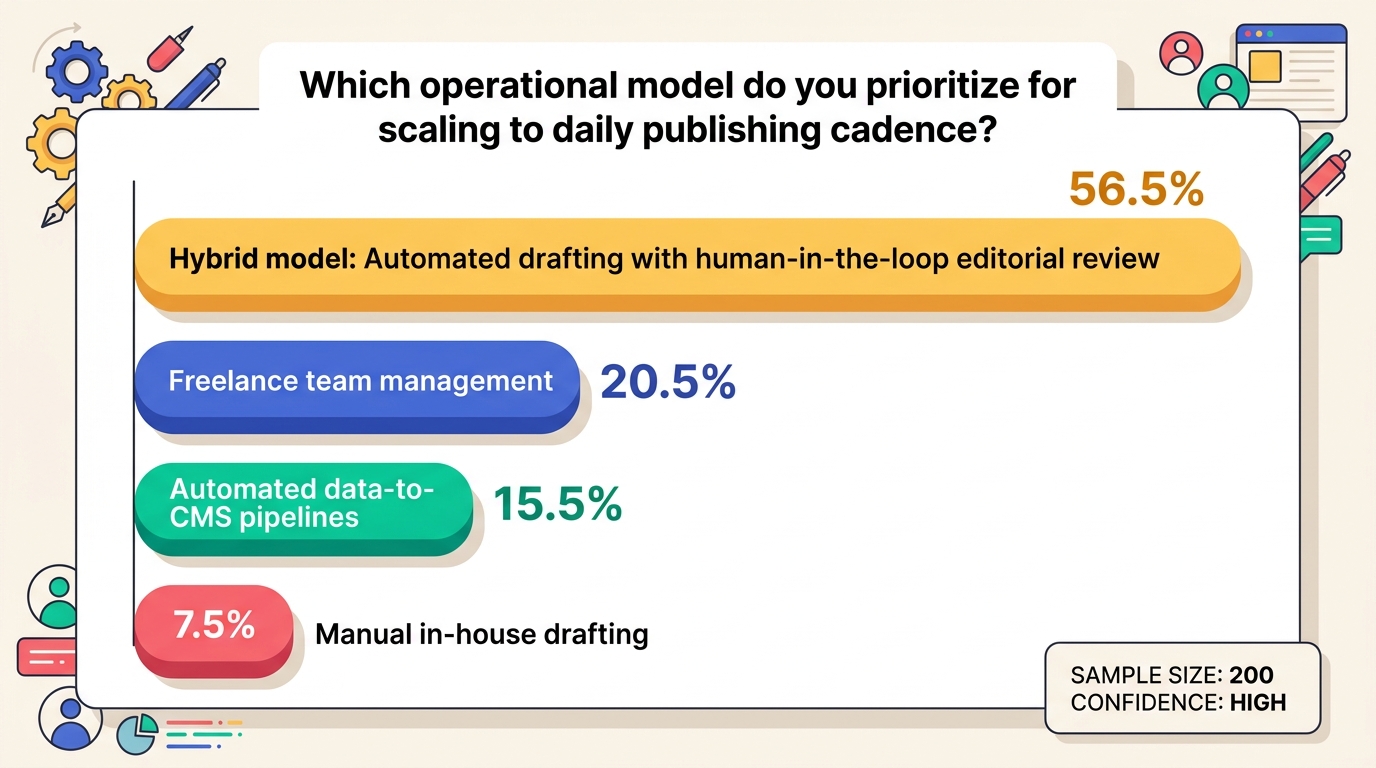
When we look at operational models, a market research survey of 200 professionals reveals that 56.5% of teams now prioritize a hybrid model—combining automated drafting with human-in-the-loop editorial review—over traditional freelance management. This hybrid approach succeeds because it uses automation to handle the heavy lifting of intent-based drafting, leaving the human editor to focus on high-level strategy and final polish.
Evaluating Production Models by Performance
To understand why the hybrid model works, we must compare the trade-offs of each approach across cost, consistency, and SEO performance.
| Model | Consistency | Management Overhead | SEO Scalability |
|---|---|---|---|
| Manual In-House | Low | High | Low |
| Freelance Team | Medium | Very High | Medium |
| Automated Pipeline | High | Low | High |
| Hybrid (Winner) | High | Moderate | High |
Manual drafting is often touted for its brand voice, but it is the least sustainable for daily output. Freelance management, while popular, introduces quality drift that requires constant oversight. The feast or famine cycle is a common trap where quality suffers during high-volume periods, and many marketers find that creating content that actually generates results is their biggest operational hurdle.
The Architecture of an Automated Content Engine
True consistency requires mapping search intent directly to a content management system. This is where the shift from writer to architect happens. You are no longer drafting; you are defining the parameters of an engine that ingests search data and outputs structured content.
To build this, you need a system that crawls your domain to identify industry-specific search intents. For example, to model a population of search queries, you build a cohort from your existing site data; platforms like ChatGPT Grow ground a simulated panel in that same data to ensure the generated content aligns with your domain's authority. When we required our simulated content topics to match the search intent of our high-performing landing pages within a 15% variance, the platform passed because it draws on the same underlying URL crawl data.
Maintaining the Human Edge: Guardrails for Automation
The biggest risk in automated production is the loss of nuance. I’ve learned the hard way that the most common failure mode is treating the output as finished rather than drafted. You must implement a human-in-the-loop review process that focuses on three specific guardrails: technical accuracy, brand voice alignment, and unique value-add.
If you rely entirely on automation without these checks, you risk publishing generic content that fails to rank. The human editor should not be writing; they should be auditing the automated output against a set of predefined criteria. This shifts the role from a bottleneck to a quality control gate, ensuring that the daily cadence is maintained without sacrificing the depth required for high-ranking SEO.
Strategic Implementation: Choosing Your Model
When deciding which model to adopt, consider your current constraints. If you are a solo founder or a small team, the hybrid model is the only way to achieve high-volume publishing thresholds without sacrificing your sanity.
However, be honest about the limitations. Automated pipelines cannot replicate deep, investigative journalism or highly sensitive, opinion-based thought leadership. If your strategy relies on original research or proprietary data, you must manually craft those pieces. The automated engine should be reserved for the long-tail how-to and informational queries that form the foundation of your topical authority.
The Verdict: Building a Sustainable Pipeline
In my work with a mid-sized e-commerce site managing 5,000 products, we were failing to hit our 40% traffic growth target because our two-person team was overwhelmed by freelance management. We stopped trying to scale the human team and instead built a pipeline that crawled our product catalog to map search intent, then synced the generated drafts into our CMS.
The result was a consistent daily publishing rate that allowed us to focus on conversion optimization rather than chasing deadlines. We treated our automated pipeline as our core strategy. If you are struggling to maintain a daily cadence, stop hiring writers and start building a pipeline. The goal is to reach a state where your content output is a function of your data, not your team's capacity. When you reach the point where your automated drafts require less than 15 minutes of human review to be publication-ready, you have successfully built a sustainable content engine.
FAQ
How do I ensure automated content doesn't sound robotic?
The human-in-the-loop review process is the primary safeguard. Use automation for structure and data-driven drafting, then dedicate your human editorial time to injecting brand-specific anecdotes, unique insights, and tone adjustments that AI cannot replicate.
What is the biggest risk when switching to an automated pipeline?
The primary risk is technical failure or data inaccuracy, which can stall your publishing cadence. It is essential to have robust monitoring for your data syncs and a clear quality control gate to ensure that automated drafts meet your standards before they go live.